




When Fractions Came to Life
At PS 125, the Ralph Bunche School, the goal wasn’t simply to teach fractions, it was to help students experience mathematics in a way that was meaningful, engaging, and memorable.

At a Glance
How One Fourth Grade Classroom Became a Community of Engineers, Scientists, and Problem Solvers
School: PS 125 – Ralph Bunche School
Program: Driving to Success: Making Fractions Easy
Grade Level: 4th Grade General Education
Learning Model: Hands-on Project-Based STEM Learning
Students Experienced
- Built, painted, and raced their own wooden race cars.
- Applied fractions, decimals, measurement, volume, speed, and the distributive property through real-world engineering challenges.
- Worked collaboratively to solve increasingly challenging mathematical problems.
Academic Skills Reinforced
- Collected and analyzed data from their own experiments.
- Fractions & Equivalent Fractions
- Decimals
- Multi-Step Word Problems

- Measurement & Volume
- Distributive Property
- Data Collection & Analysis
- Scientific Investigation
- Engineering Design Process
Results
- Students remained highly engaged throughout the program.
- Many students successfully completed challenging multi-step word problems.
- One student shared that the program helped her understand the distributive property.
- Students gained confidence as lessons progressed from foundational concepts to more advanced applications.

The Challenge
Like many elementary classrooms, students entered the program with varying levels of confidence in mathematics. Some are eager to tackle new challenges, while others often disengaged when math becomes difficult. The Driving to Success: Making Fractions Easy program is designed to change that by transforming mathematics into something fun; something they can build, measure, test, and most importantly experience.
The Experience
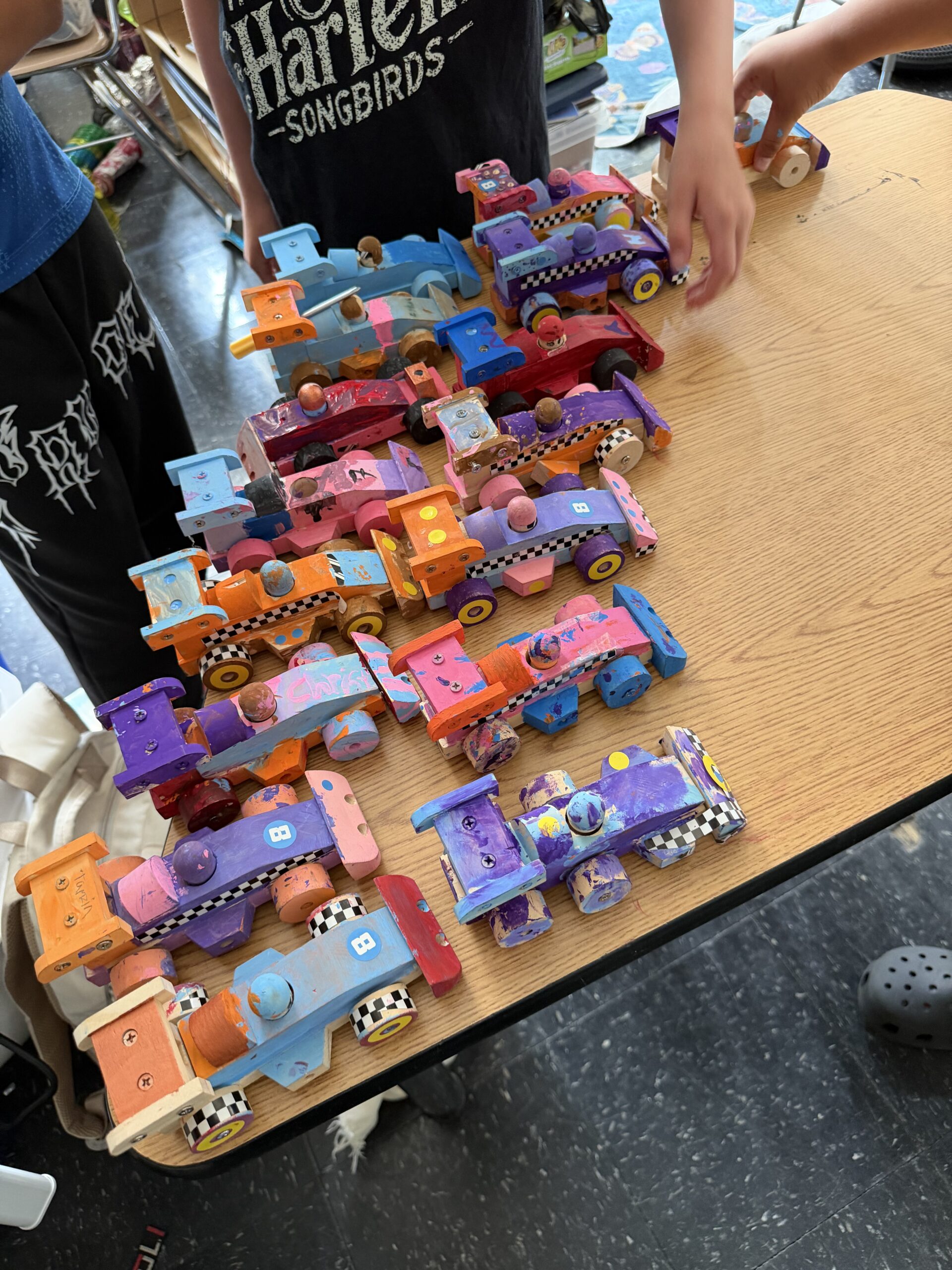
From the moment students opened their race car kits, the classroom buzzed with conversation, creativity, and curiosity. Wooden race cars covered the tables. Paint palettes sat beside interactive math workbooks. Instead of quietly completing worksheets, students debated ideas, measured distances, tightened screws, and proudly admired the cars they had built themselves.
The experience began with mathematics.
Students worked together to solve increasingly challenging fraction problems, discuss their thinking, and explain their reasoning to classmates. Rather than simply memorizing procedures, they learned to collaborate, ask questions, and support one another as mathematicians.
Once the cars were assembled, the classroom transformed again.

Paintbrushes replaced screwdrivers as students personalized their creations with bold colors, racing stripes, checkerboard patterns, and unique designs. Every car reflected the personality of its builder, giving each student ownership of both the engineering process and the learning experience.
As the lessons progressed, students assembled their own wooden race cars piece by piece. What looked like a simple construction project quickly became an engineering challenge.
The race cars quickly became more than works of art.
They became mathematical tools.
Students measured the dimensions of their cars to calculate volume. They converted decimals into fractions, created line plots, solved multi-step word problems, and explored other complex mathematical concepts. They also learned about the mathematical achievements of Ancient Egypt, discovering that ideas such as volume and measurement have helped civilizations solve real-world problems for thousands of years.
When race day arrived, the classroom became a laboratory.
Students carefully lined up their cars at the top of the ramp, measured distances, timed each run, and used the formula Speed = Distance ÷ Time to analyze the performance of their vehicles.
Every race generated new data, new questions, and new opportunities to apply mathematics in meaningful ways.
Evidence of Impact

The greatest victory wasn’t measured by which car crossed the finish line first.
It was measured by the students themselves.
One student shared that she loved how the lessons began with simple ideas before gradually becoming more challenging, giving her the confidence to tackle problems she once thought were too difficult.
Another proudly explained that she finally understood the distributive property after completing the activities.
Educator Feedback
Paraprofessional Observation: “Many of the students who normally check out during math stayed engaged and focused. I wish they had something like this in math class.”
Teacher Reflection: “We really enjoyed getting to engage with the race cars and the interactive workbook. We hope to continue this opportunity next school year and organize our own Race Car STEAM Fair.”
The Lasting Impact
The photographs tell the story just as clearly as the words.
Students weren’t simply completing another classroom assignment.
They were thinking like engineers.
Working like scientists.
Creating like artists.
Reasoning like mathematicians.
Supporting one another as teammates.
Most importantly, they discovered that mathematics is not a collection of rules found only inside a textbook. It is something that can be touched, built, measured, tested, improved, discussed, and celebrated.
Driving to Success: Making Fractions Easy did far more than teach fractions.
It transformed a classroom into a community of curious learners where every student had the opportunity to build confidence, develop perseverance, and experience the joy of solving real problems.
Because when learning becomes an adventure, students don’t just remember the lesson.
They remember that they are capable of succeeding.